
Imagination At Work
Imagination made visible.

The most complicated skill is to be simple.
My father knew this. He sat at a drawing board creating blueprints for aircraft using a pencil, paper, and a T-square. Every thought was considered. Every line was a decision. Even though there were a few things more complex than what he was helping make. Precision in the service of creation. Making the impossible flyable.
A simple truth is that only by appreciating the complicated can we survive.
Simple is very contextual. Simple pleasures like reading a book, taking a walk. Nothing is simple in business, though. Although it’s a fine objective, and making the complex simple is always the aim, it’s a leader’s obligation to recognise that it’s complex.
I don't often talk about what I do. It's never felt necessary.
But fifty years on, there's an irony too pointed to ignore: that in an age overwhelmed by digital everything, the most useful thing I can offer is a marker, a wall, and the willingness to listen. Analogue as antidote. It feels both unlikely and urgent, which is why I'm saying it now.
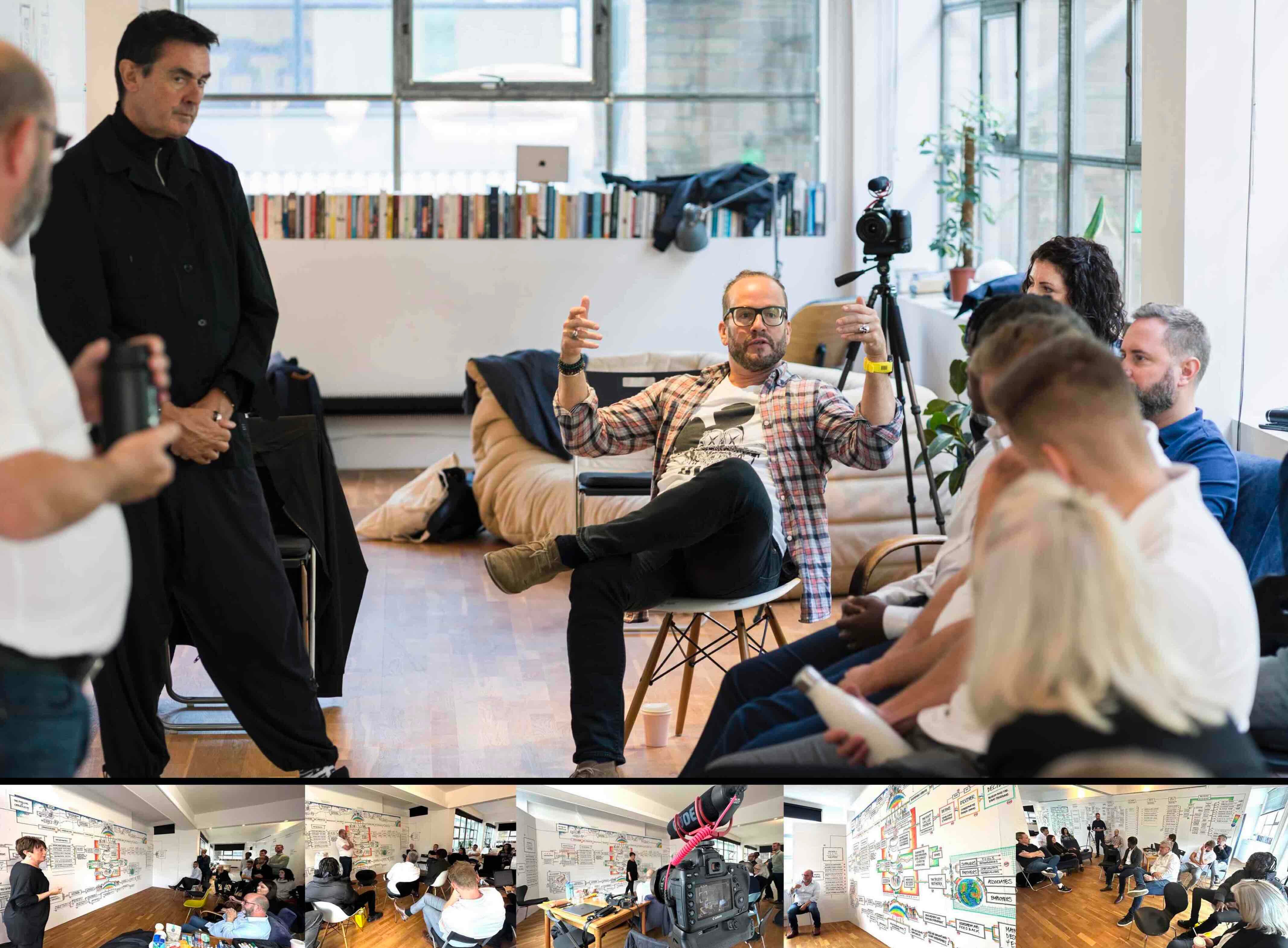
I draw on large walls. I work with leadership teams. The walls represent the conclusions I draw from the responses to my questions. They are posed within a logical framework. That logic is designed to force sense.
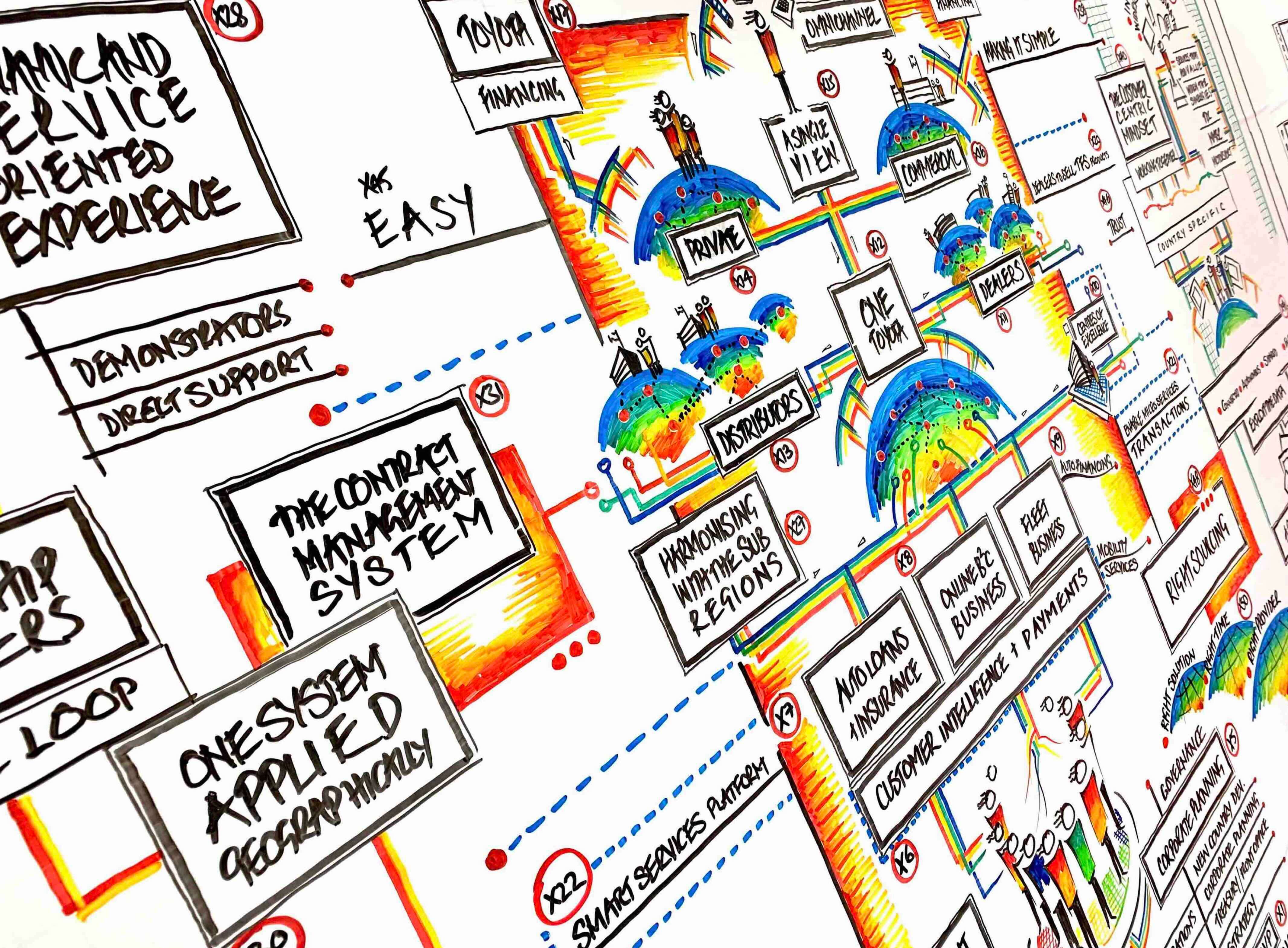
Drawing while listening is cognitive juggling - a synthesis in real time.
You’re holding multiple threads, sensing which ones to pull, deciding what to leave out. Beyond verbatim capture, this is about real-time translation. Translation requires understanding, which requires presence. And no algorithm does presence - yet.
A couple of decades ago, the main idea was to avoid solving the wrong problems. That was because that’s what so many were doing.
The challenge today is a lot more significant. It’s rare to solve any problem today that lives in supreme isolation. That was also true back then, but something else has happened.
The world layered and layered itself with abundance and complexity. At the same time, attention became impoverished. I didn't realise it back then, but compared to how slow and frustrating the creation of strategic value can be today, drawing out a cogent result in days, not weeks and months, has taken on a whole new importance.
Now the majority aim is to compress the time available to deliver a result and accelerate deployment. Oh, and at the same time, not solve the wrong problem really well.
Yes, a drawing makes things simple, but it still requires a composite leap from multiple sets of inputs. It may be 20 people having a conversation or the result of spotting a pattern from a different conversation that happened earlier. It could be the sum of several experiences elsewhere that nudged the inference in some critical way. The result is simple, but doing justice to the process is complicated.
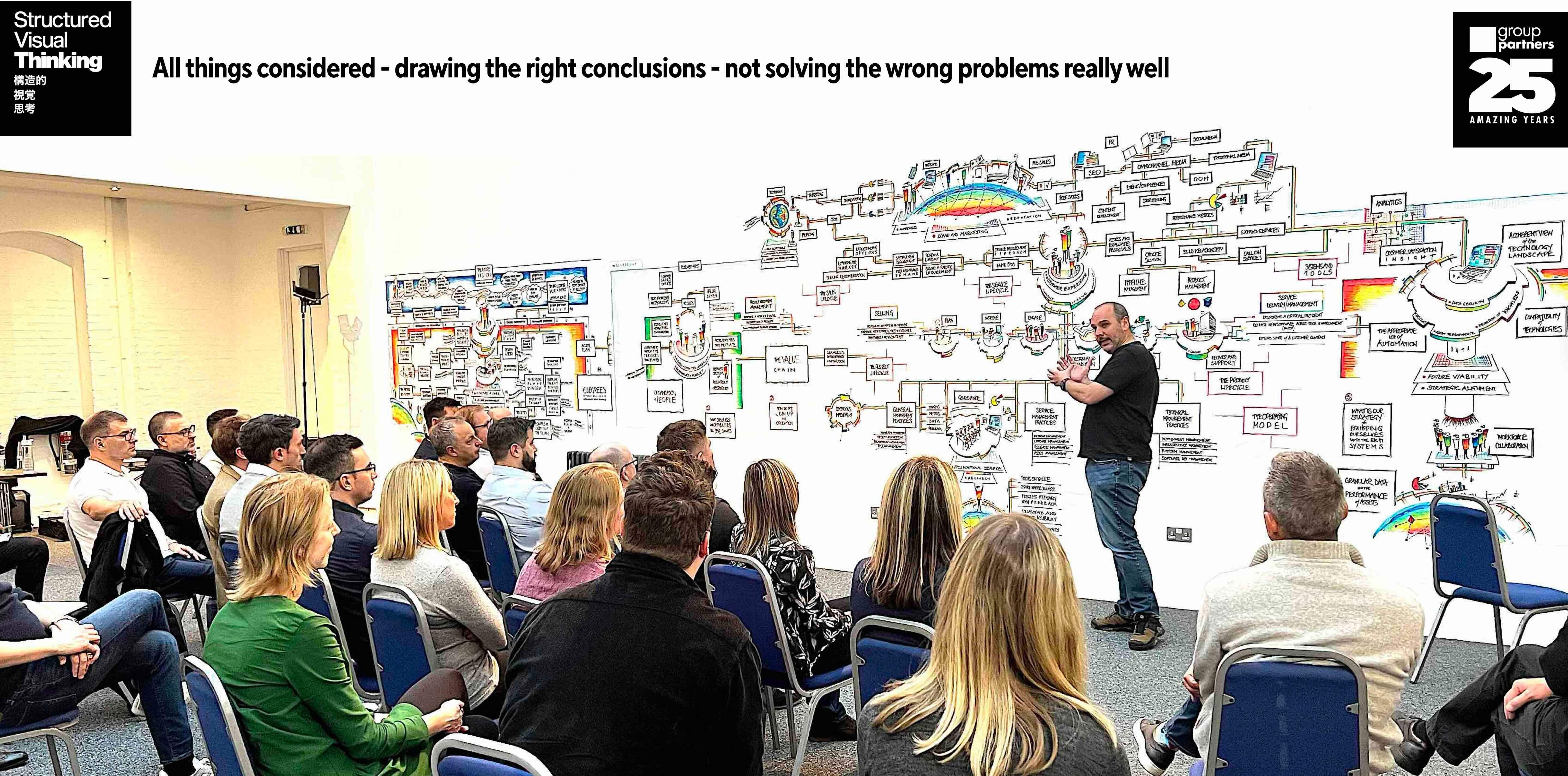
The walls matter.
A hundred feet long. Eight feet tall. When you surround people with the architecture of their own thinking, drawn live, at scale, something fundamental shifts.
It stops being a meeting. It becomes a world they built and can now occupy. Safe enough to think dangerously. Big enough to see the whole system of the business. Intimate enough to find themselves in it.
In a digital era drowning in pixels, ‘working analogue’ becomes radical. Taking inspiration from my father - marker in hand, but an imperfect line. The commitment of ink that cannot be undone with a keystroke, but a meaningful conversation.
There’s a reason we remember what we draw and forget what we scroll past.
My method took shape 50 years ago from a specific frustration
It was the early eighties. I was in too many meetings where critical thinking was missing, but was desperately needed. Yes, challenges were discussed, but there was little, if any, cross-group clarity, ownership, engagement, or inspiration.
I felt that, for the sake of progress, these things should be built into the agenda and not treated as a separate action. I took to the flip charts and whiteboards as an act of intervention and rebellion.
It became the only thing I wanted to do 25 years later, but it was always a key part of how I had conversations.
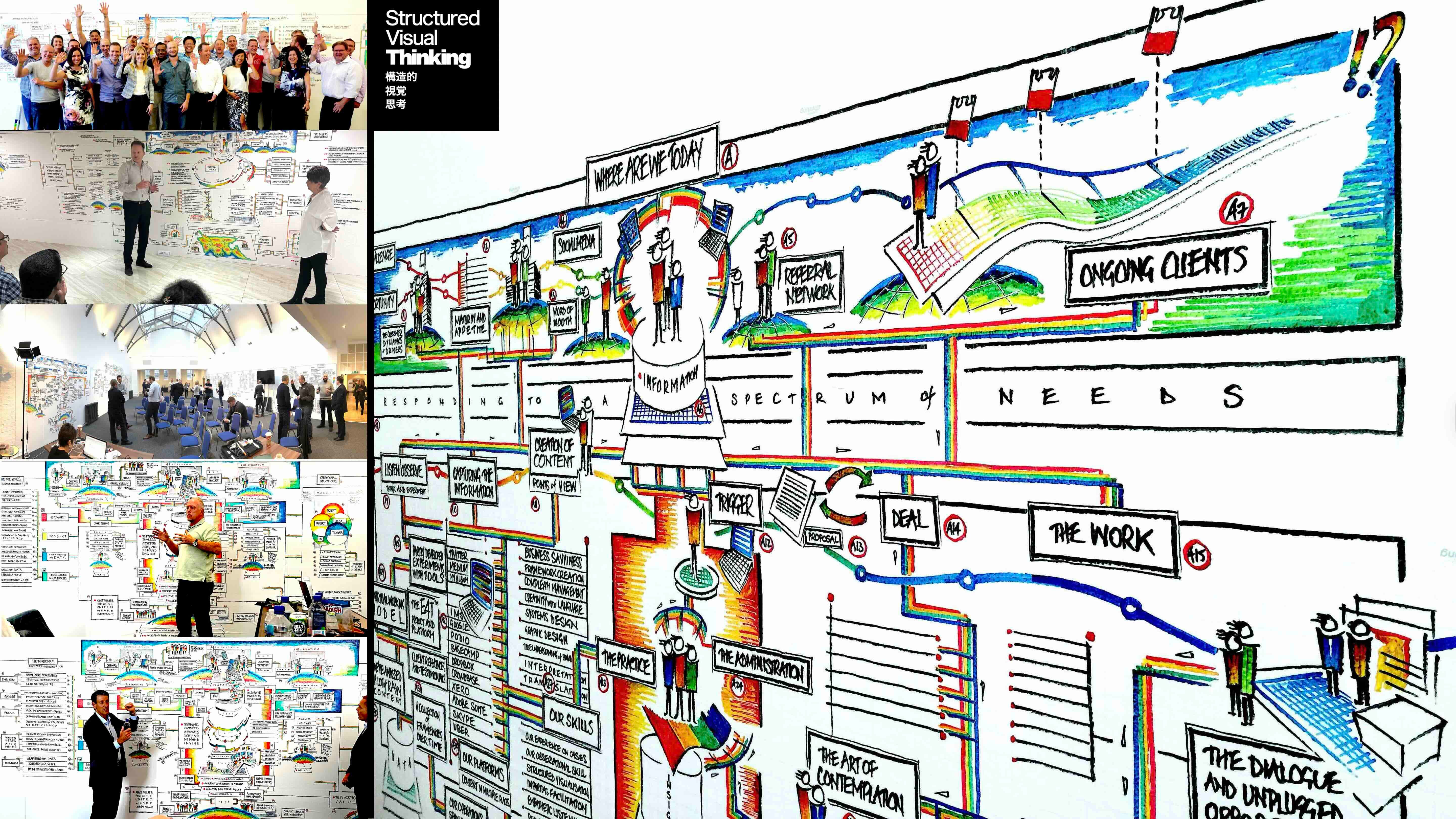
Something happens when people watch their thinking take shape on a wall.
It’s not just cognitive. It’s emotional. There’s a quiet pride in seeing your contribution become part of something larger. Even just a line, a connection, a cluster of ideas that suddenly coheres. People point at the wall and say ‘that’s what I meant’ even when they couldn’t have articulated it ten minutes earlier.
The drawing gave their intuition a home.
This is the part that’s hard to measure but impossible to ignore. The subconscious registers an innate connection to craft. People may not consciously notice the balance of a composition, the rhythm of how ideas are grouped, or the way negative space gives the eye permission to rest. But they feel it. A wall that looks considered feels trustworthy. A wall that looks careless undermines the very thinking it’s meant to represent.
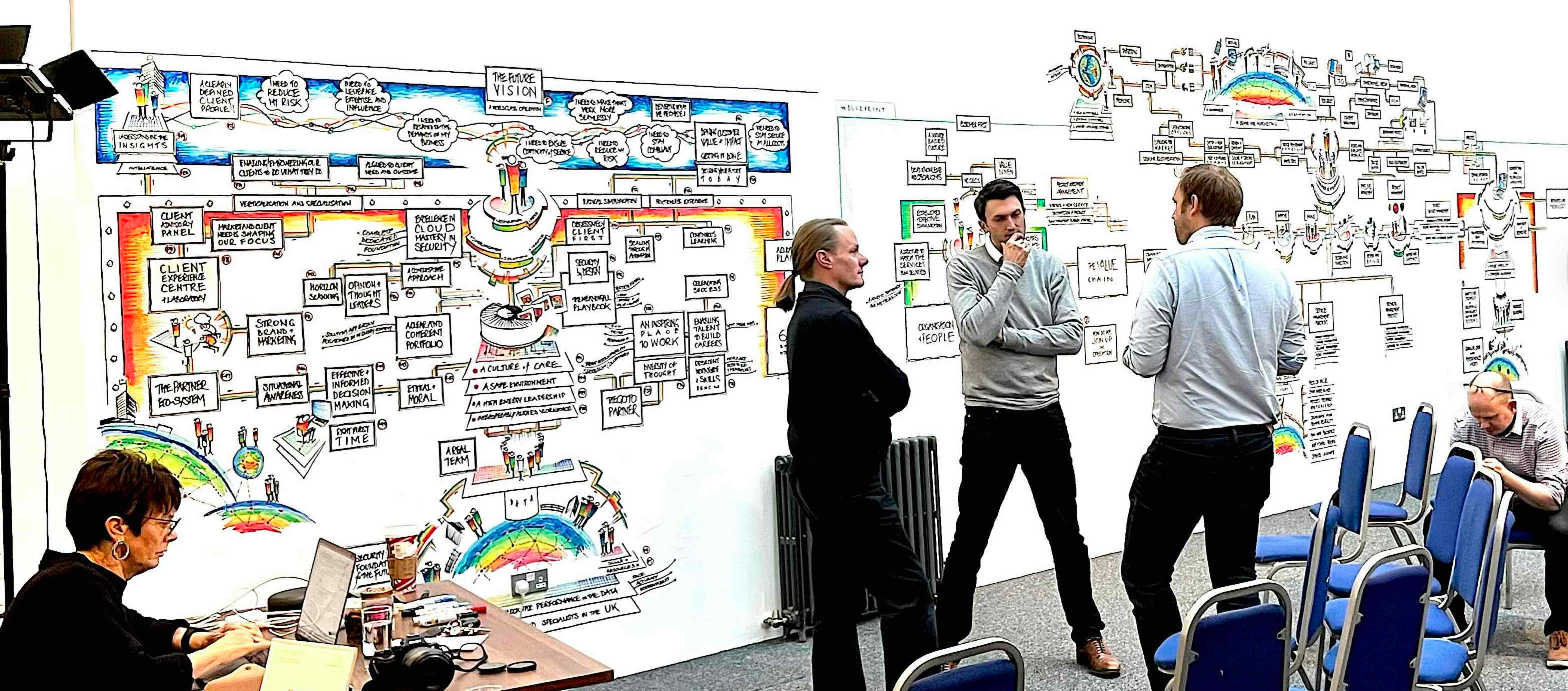
The attention to aesthetics is not really about decoration; it’s a signal that someone cares enough about the group's energy to get this right.
And care is contagious. When people see their messy, half-formed thoughts treated with respect, given structure, given weight, given visual dignity, they invest differently. They defend the work because it feels like theirs. Not handed down. Not imposed. Built in their presence, from their words, with their fingerprints all over it.
This is about commitment. And that matters.
People don’t resist change because they fear the future. They resist because they weren’t present when the future was imagined. Working this way solves that. It makes the act of creation witnessed and shared. It turns strategy from a document that arrives in an inbox or a town hall into an experience that happened between them.
Creativity in action has a texture.
It has a pace, sometimes slow and deliberate, sometimes fast and instinctive. It has moments of silence when the room holds its breath waiting for the next line. These are the conditions under which ownership forms.
Fifty years of refinement. Twenty-five years of obsession. And still, every wall teaches me something about what people need but rarely ask for: to see themselves thinking clearly, together, about something that matters.
Individuals heard. Imagination made visible. Imagination at work.
Fantastic work, John.
People working together, co-creating, building on each other's ideas, and developing a sense of collective ownership in the process. Add a dash of expert facilitation and artistry, and you’ve got applied creativity in action.
I read a Substack post recently from someone who said he was using AI to create infographics in the style of Magic Marker on Whiteboard, because they produced many times more engagement than the slick illustrative AI outputs he was using.
Missing the point somewhat, me thinks.
I have watched and participated in, this process so many times and can attest to its effectiveness. However what you don’t mention is that it is a lot more than this that makes it work. Yes you are a very talented artist and that is what most people comment on.
However the real essence is your intelligence, experience, curiosity and incredible ability to unpack complexity and address issues with clarity to enable deeper understanding.
It’s even more than that but I don’t have all afternoon to sit around here blowing smoke!