
A Perfect Note
Numbness never sounded more alive.

There’s a thing David Gilmour does.
You’ve heard it. A note that arrives ever so slightly before it needs to, hangs for a beat longer than it should. But always resolves with perfection.
Not fast. Not showy. Just exactly right.
The space between the notes matters as much as the notes. I would argue more.

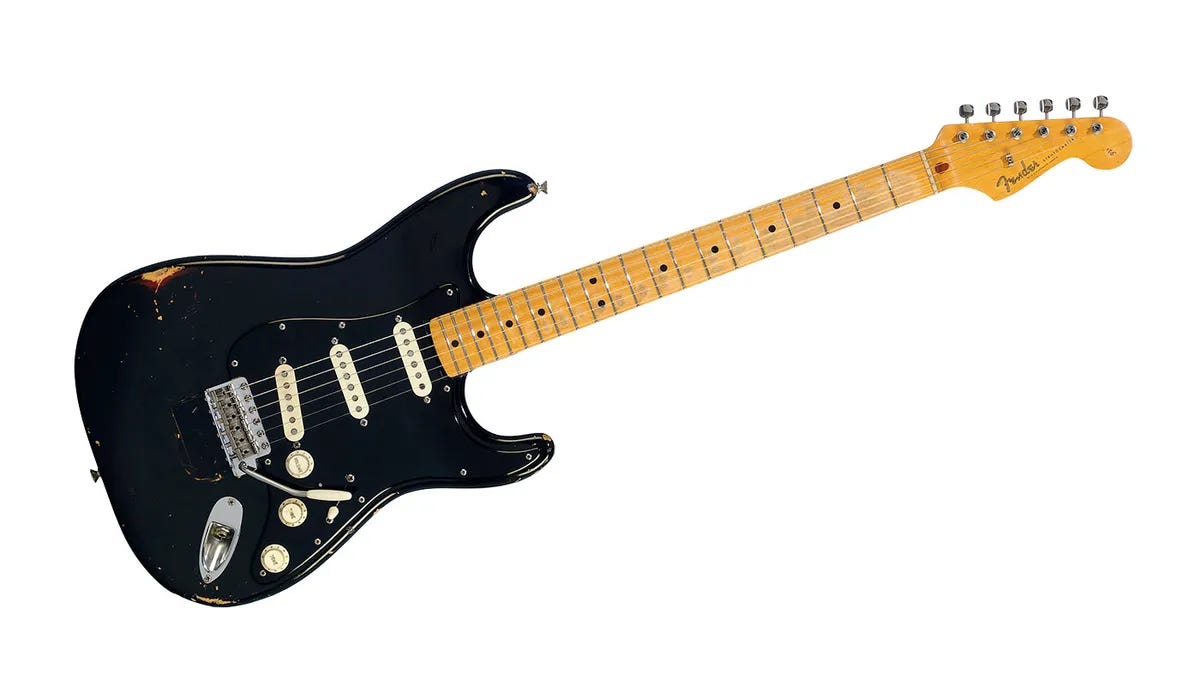
Last week, the guitar he made most of that music with sold for $14.6 million.
He had already sold it some years earlier for charity. The Black Strat. A battered, modified, re-necked, re-pickuped 1969 Fender he snagged at Manny’s music shop in New York for a few hundred dollars, because another one had been stolen in New Orleans. (Never to be found)
He treated it like a tool.
Swapped the neck. Changed the pickups. Added a tremolo. Replaced the knobs. Kept making it fit what he needed from it, rather than preserving what it looked like it should be. The guitar we see in all the photographs was always becoming something else.
The music it made has a voice we can recognise in a few notes. Not because of the guitar. Because of David.
And think about what that music was actually about.
Pink Floyd weren’t singing about true love and sunsets.
Wish You Were Here is about Syd Barrett descending into madness, a man so gone he turned up at the Abbey Road sessions unrecognised by the rest of the band. The Wall is about brick-by-brick emotional desolation. Animals is about the brutality of hierarchy, the strong consuming the weak. The Dark Side of the Moon is time running out, money corroding, the mind cracking, and the last heartbeat.
Dark subject matter.
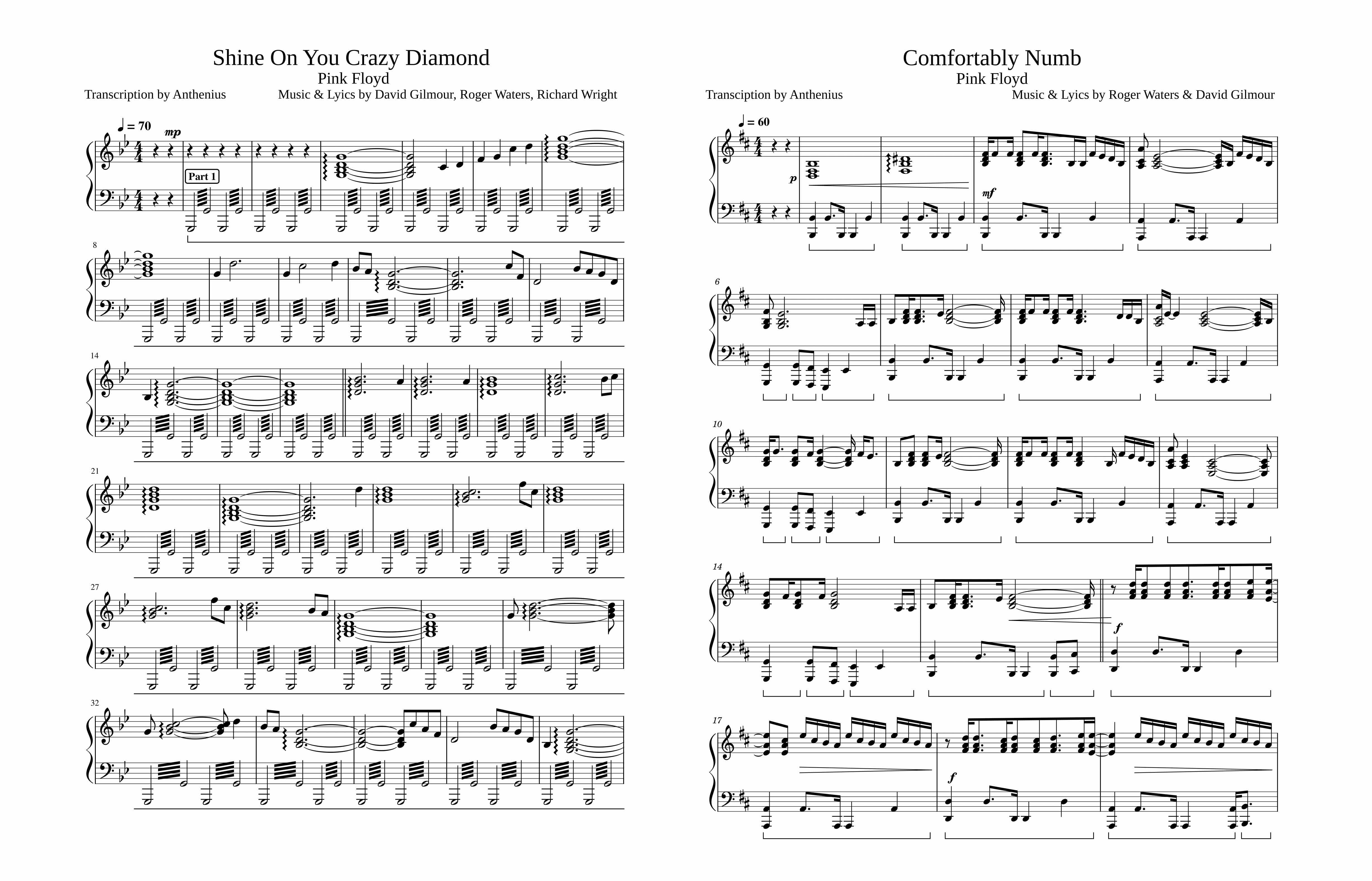
And yet the music takes you to a beautiful place. You put on Comfortably Numb, and whatever is going on in your life (a lot right now), something shifts. Shine On You Crazy Diamond opens with four notes, then four more. Then something happens that feels like your chest is about to burst open.
How can music made about the worst of human experience make you feel this safe? More present? Less alone?
It's a personal take, but I think it's a commitment to the note and the space between. That and the refusal to ornament it in a regular sense. Also, a complete absence of hurry.
Gilmour plays like he doesn’t need to prove anything. The note arrives when it arrives. It stays as long as it stays. In this fucked up world of relentless acceleration and automation, of noise marketed as meaning, of thought compressed to the point of invisibility and humanity discarded in favour of the few, what will take the place of craft like this?
He stood in a studio in France in 1979 and played a solo over a track about numbness and disconnection. That track contains more humanity than most things ever will.
The guitar sold for $14.6 million. Someone wanted to own the object. I understand the impulse, even if the number is crazy.
Luckily, the real thing of value can’t be bought. It’s in my head. It’s been given to all of us. It lives in the recording. In the way millions of people over fifty years have put on headphones in dark moments and found something in those sounds that made the darkness slightly less total.
Enjoyed this thank you. However, and accepting that he’s become a anti-semitic madman in recent years, it’s worth acknowledging the genius composer of all of this stuff was Roger Waters. I love DG - crossed the pond from London to pay homage to him at Madison Square Garden last year, and his guitar created the soundtrack to my life, but I’m not sure how much it could sing without Roger’s compositional skills
Brilliant article, John. It would make a wonderful documentary. I kept on envisioning your voice on top of the music with video clips from live concerts of his playing.
If there’s a single exquisite example of the tensions of playing in the space between, this is it!